Blog · · 5 min read
Where each POS stops handling a special order
A special order travels six stages from counter to pickup. Shopify POS Pro stops at stage 02, WooCommerce at 04, Lightspeed at 05. Here is what happens after that.
- Special orders
- Retail operations
- Point of sale
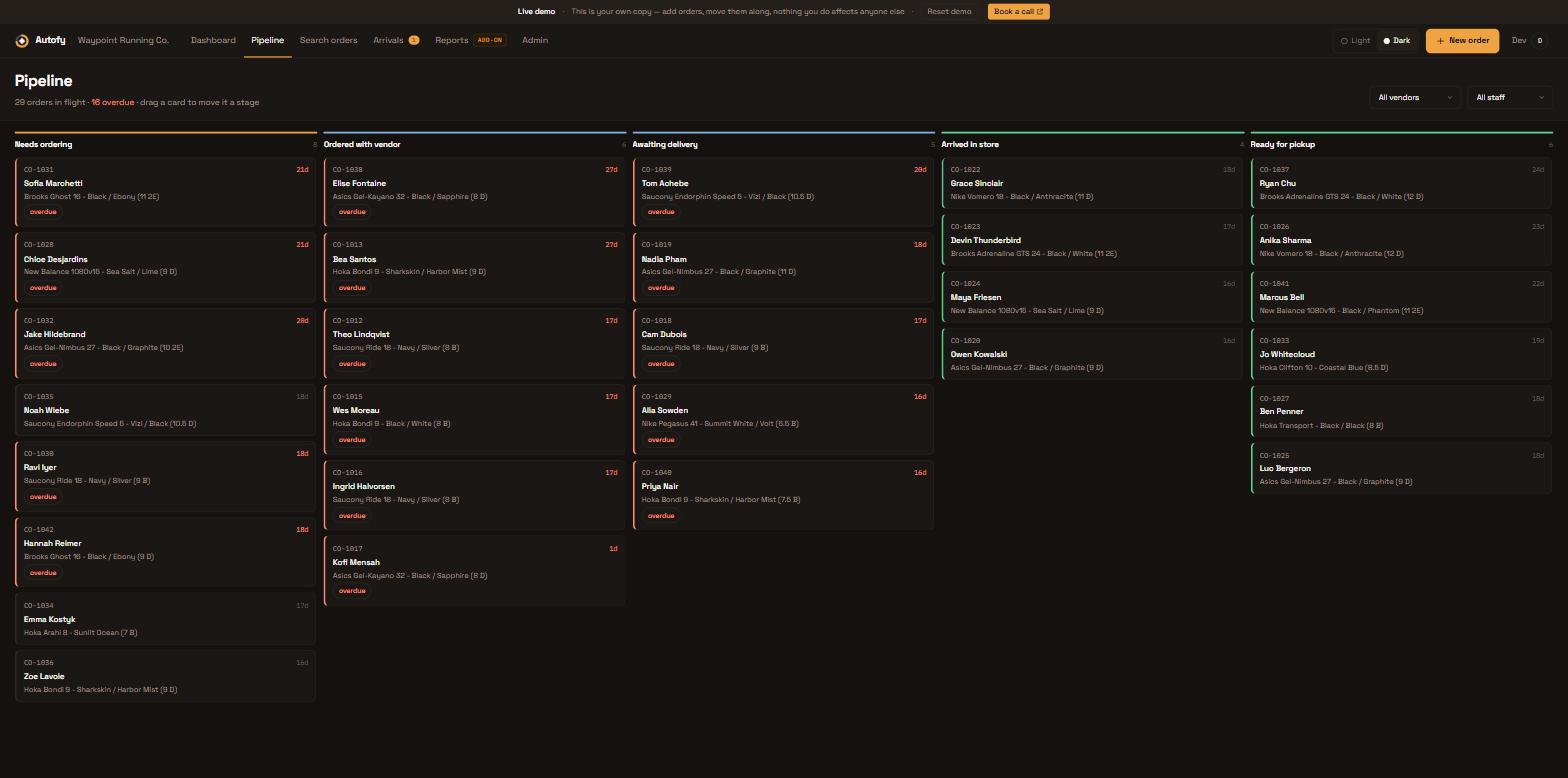
A special order is not one event. It is six, spread over days or weeks, and every system you might run them on gives up somewhere in the middle.
Key Takeaways
- A special order travels six stages: take it, hold it, link the vendor order, catch the arrival, tell the customer, chase it to pickup.
- Read from vendor documentation in September 2026, Shopify POS Pro stops at stage 02, WooCommerce at stage 04, and Lightspeed X-Series at stage 05.
- All three stop somewhere in stages 04 to 06 — the half that depends on a person remembering.
- Stage 04, catching the arrival, fails silently: the goods are in the building and nothing looks wrong until the customer calls.
What are the six stages of a special order?
Six things have to happen between a customer asking for something you don't have and that customer walking out with it.
- Take it at the counter. Capture the request while the customer is standing there.
- Hold it with no stock. The order exists before the goods do, so something has to represent it.
- Link the vendor order. Connect what you promised a customer to what you ordered from a supplier.
- Catch the arrival. A carton lands with thirteen pairs in it. One belongs to someone who has been waiting three weeks.
- Tell the customer. The step that turns a fulfilled order into a happy one, and the one most often forgotten.
- Chase it to pickup. An order sitting in the back room is not finished.
Stages one to three are paperwork. Four to six are memory. That split explains most of what goes wrong.
Where does each POS stop?
Each of the three systems below carries the early stages and hands back a later one. The table reads left to right in the order a real order travels.
| Stage | Shopify POS Pro | Lightspeed X-Series | WooCommerce |
|---|---|---|---|
| 01 Take it at the counter | Yes (Pro tier) | Yes | Yes |
| 02 Hold it with no stock | No | Yes | Yes |
| 03 Link the vendor order | No | Yes (beta) | No |
| 04 Catch the arrival | No | Partial | No |
| 05 Tell the customer | Yes | No | No |
| 06 Chase it to pickup | Yes | Yes | No |
The line turns red at 02 for Shopify POS Pro, 04 for WooCommerce, and 05 for Lightspeed X-Series. Every one of them stops somewhere in the memory half.
These verdicts are read from each vendor's published documentation as of 17 September 2026, with the quoted wording and caveats shown on the full POS comparison. Features a vendor marks beta may differ by account and plan.
The three stopping points, in each vendor's own words:
- Shopify POS Pro, stage 02. Shopify's documentation states that by default, pickup in store is available only when the entire order is in stock at the pickup location (Shopify Help Center, "Setting up pickup in store for online orders"). A vendor is not one of your locations, so an order you have not received yet cannot be held this way.
- WooCommerce, stage 04. The backorder setting named "Allow, but notify customer" shows a notice on the product page, cart, checkout, order and customer emails — all at purchase time (WooCommerce, "Product Editor settings"). Nothing fires when the goods actually arrive.
- Lightspeed X-Series, stage 05. Lightspeed's special orders documentation instructs staff to contact the customer to let them know the order is ready for collection (Lightspeed Retail X-Series, "Managing special orders"). That is a person's job, not the system's.
Why is stage 04 the expensive one?
Because when stage 04 fails, nothing looks wrong. The goods are in the building. The vendor invoice is paid. The POS shows stock on hand. The only missing thing is the link between that carton and the customer waiting for it — and that link lived in somebody's head.
The order never appears as late. It appears as a phone call, three weeks later, from a customer who is no longer happy.
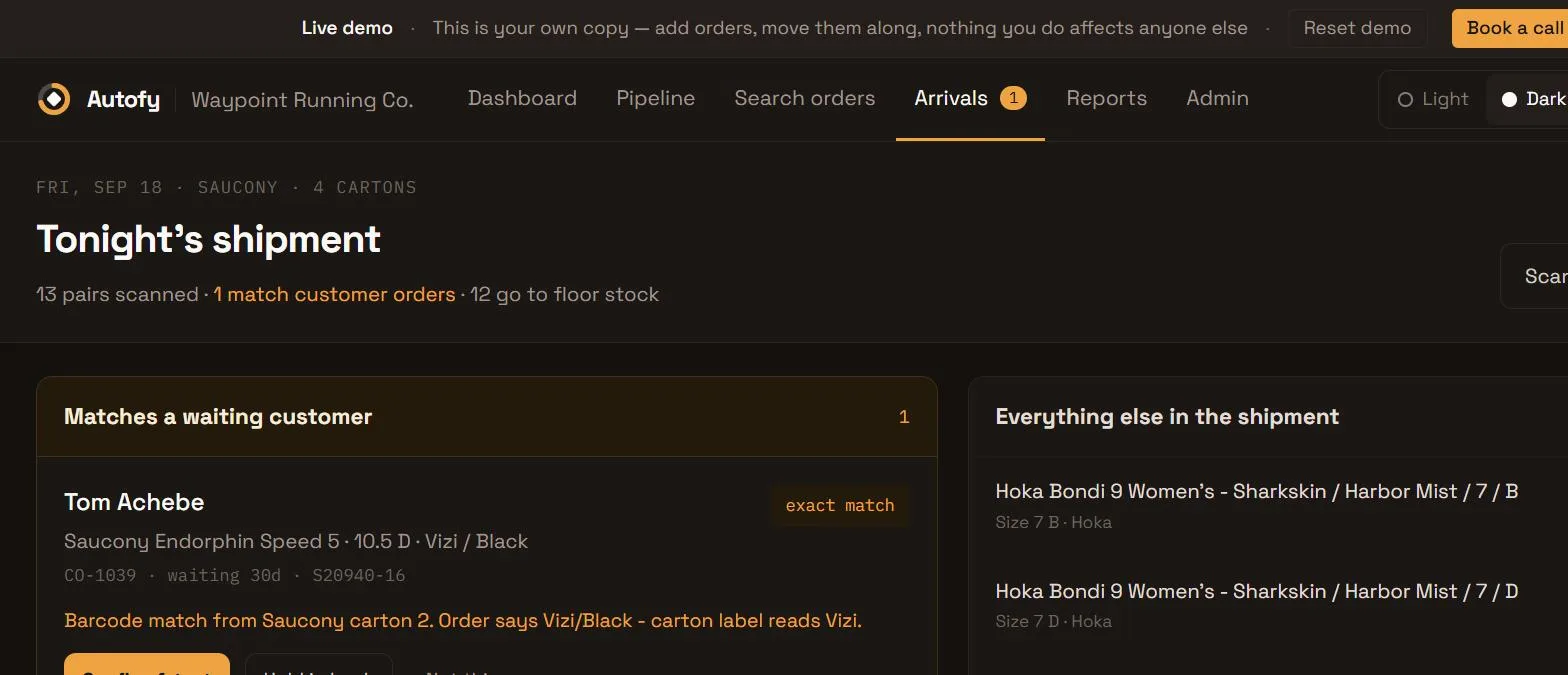
Stage 04 is a matching problem, not a receiving problem. The question is not "did the carton arrive" but "whose is it" — and that is the part a receiving workflow built around stock levels does not ask.
That is why "our POS handles special orders" can be true and still leave you exposed. It handles the stages that generate paperwork. It doesn't handle the one that requires someone to notice.
How do you tell if this is costing you?
You don't need software to find out. Take your last twenty special orders and ask three questions:
- At which of the six stages did a person have to remember something?
- How many are past their promised date right now?
- Who would notice if one had sat in the back room for a month?
If the answer to the third is "nobody, until the customer calls," your gap is stages four to six. That is a process problem before it is a software problem, and naming the failing stage is most of the fix.
Frequently asked questions
Does my POS already do this?
Partly. All three systems above take the order at the counter, and two of the three hold it without stock. The differences start at stage 03 and widen after that. Check your own system against the six stages rather than against the phrase "special orders" in a feature list.
What is the difference between a special order and a backorder?
A backorder is stock you expect to restock anyway. A special order is bought for one named customer, which is why stage 05 matters: nobody is waiting on a backorder by name.
Is stage 03 worth solving on its own?
Rarely. Linking the vendor order helps, but if stage 04 still hands back to memory, the order can still go quiet after it arrives. The stages fail as a chain.
Where Autofy comes into it
Autofy is a special order tracker that carries all six stages rather than the first few. That is the whole product and the reason it exists. If you want to see it against your own orders, tell us how they move through your shop today.
But the six stages are worth knowing whatever you run them on. Most of the improvement available to a shop with a special-order problem comes from naming which stage is failing — not from replacing the till.