Blog · · 6 min read
Special order vs backorder vs pre-order: what each one means at the counter
A backorder is stock you already carry that ran out. A pre-order sells before the item exists. A special order is bought for one named customer.
- Special orders
- Retail operations
Three words get used at the counter for three different situations, and mixing them up is how a shop promises the wrong thing. A backorder is stock you already carry that happens to be out. A pre-order sells an item before it exists to sell at all. A special order is bought against one customer's name for something you don't otherwise stock. The difference isn't academic. It changes what you tell the customer, whether you take a deposit, and whether the item needs tracking against a name from the moment it's promised.
Key Takeaways
- A backorder is an item you normally stock that's temporarily unavailable. The store owns it. No single customer's name is attached until someone happens to buy it.
- A pre-order sells a product before it's released or normally available, usually with payment taken upfront to hold the reservation.
- A special order is bought against one customer's name for something you don't otherwise carry. It doesn't exist in your store until that customer asks for it.
- Only a special order needs a name attached to it from the moment it's placed. That's the operational difference that matters at the counter.
- The three can overlap. A not-yet-released item ordered for one named customer is both a pre-order and a special order at once.
What is a backorder?
A backorder is an item you normally carry that has sold through faster than you restocked it. Shopify's own guidance describes a backorder as stock a seller "normally carries" that has gone "temporarily out of stock." The sale is still accepted, against an expected restock date (read from Shopify, "Backorders: Meaning, Causes, and Management Tips", September 2026).
The key thing about a backorder is who it belongs to: nobody, specifically, until somebody buys it. If twelve pairs of a running shoe come in on backorder, they go to whichever twelve customers bought first, in whatever order the till processed them. That's an inventory problem, and most systems, including the ones this site has compared for special orders, already track it: a stock level goes to zero, a flag goes up, a restock date gets estimated.
What is a pre-order?
A pre-order sells a product before it's released or otherwise available to buy at all. The item hasn't existed in your store's inventory before now. That's what separates it from a backorder: a backorder item was in stock at some point and ran out. A pre-order item was never in stock, because it isn't out yet. A bike shop that lets a customer put a deposit down on next season's frame before it lands in the country is running a pre-order.
Pre-orders are usually paid for, at least partly, at the time they're placed, because the shop is asking a customer to commit before there's anything to hand over. That upfront commitment is the whole point: it tells the shop how many to bring in.
What is a special order?
A special order is bought against one customer's name for something the shop doesn't otherwise stock. A jeweller who orders a ring in a size the case doesn't carry, or a shop that special-orders a rifle in a caliber it doesn't normally shelve, is placing a special order. Nobody else can buy that item off the shelf, because it was never headed for the shelf. It exists because one customer asked for it.
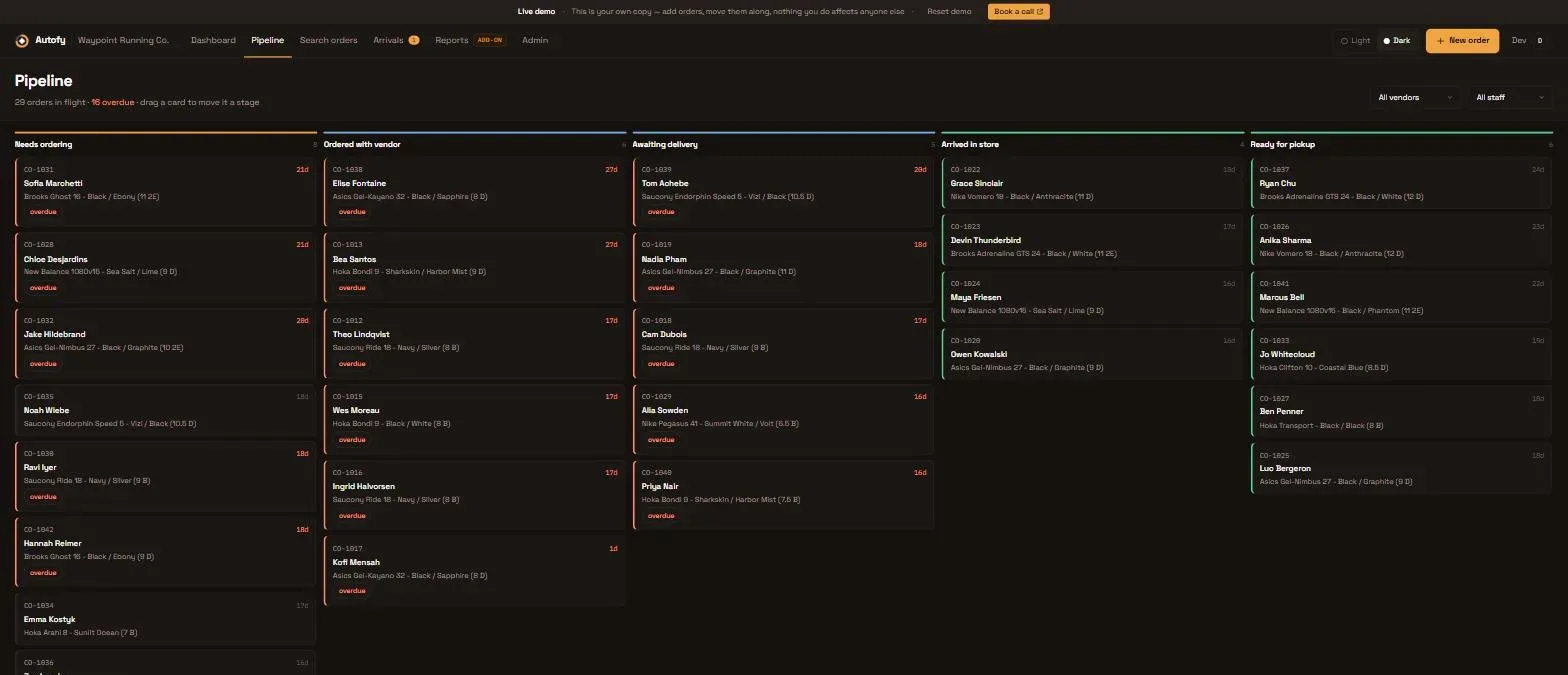
That single-customer link is what makes a special order different from the other two, and it's why it needs to be tracked differently. A special order travels six stages from counter to pickup, and every one of those stages has to stay attached to the same name. Lose that link partway through, and the item can arrive, sit on a shelf, and never find its way to the person who asked for it.
Lightspeed's own special orders documentation frames the last stage the same way. It instructs staff to contact the customer once the order is ready for collection (read from Lightspeed Retail X-Series, "Managing special orders", 17 September 2026). That instruction only makes sense when one customer's name is attached to the order. Neither a backorder nor a pre-order carries it, because neither is written against one name.
Backorder, pre-order, special order: the difference at a glance
| Backorder | Pre-order | Special order | |
|---|---|---|---|
| Normally stocked here? | Yes, temporarily out | No, not released yet | No, and often never will be |
| Whose name is on it? | Nobody's, until it sells | Whoever ordered it, if limited | One customer, from the start |
| What triggers it? | An item you carry sells through | A product opens for early orders | A customer asks for something you don't carry |
| Typical payment timing | At sale, like a normal item | Often a deposit or payment upfront | Usually a deposit at order, by shop policy |
| Does it need a name tracked through fulfillment? | No | Only if quantity is limited | Always |
Why the distinction matters at the counter
Getting this right at the moment a customer asks changes what happens next. Call a special order a backorder, and staff may treat it like ordinary restocking, something that shows up on a shelf report rather than something somebody is waiting on by name. Call a backorder a special order, and a customer may expect a phone call that was never going to come, because the item was headed for general stock the whole time.
The practical test is simple: is this item for anyone, or for one person? A backorder is for anyone; it just isn't in the building yet. A pre-order is for whoever ordered ahead of release. A special order is for one person, and the shop has to remember that from the request to the pickup. That's paperwork for the first three stages and memory for the last three, and the memory part is where special orders go missing.
Frequently asked questions
Is a backorder the same thing as a special order?
No. A backorder is stock the shop already carries that's temporarily out; it belongs to the shop's general inventory, not to one customer, until it sells. A special order exists because one customer asked for something the shop doesn't otherwise stock, and it stays tied to that customer's name the whole way through.
Can something be both a pre-order and a special order?
Yes. If a customer asks for a specific configuration of a product that hasn't been released yet, the shop is both taking an order ahead of availability and promising it to one named person. The tracking problem is the special order's: it still needs that name carried through to pickup.
Does my POS use these words the same way I do?
Not always. WooCommerce, for example, uses a product-level "backorder" setting to notify a customer that a purchased item isn't currently in stock. There's no separate concept of a named special order underneath it (read from WooCommerce, "Product Editor settings", 17 September 2026). That's a wider use of the word than the one this post draws. Check the comparison of what each POS actually does with a special order rather than trusting a menu label to match the definition here.
Where Autofy comes into it
Autofy tracks special orders specifically: the ones bought against one customer's name, from the counter to pickup. Backorders and pre-orders usually don't need that kind of tracking, because nobody specific is waiting on them until they sell. If special orders are the ones going quiet in your shop, tell us how they move through your counter today.
Whatever you run them on, the words are worth getting straight first. A customer who hears "special order" and a customer who hears "backorder" have learned two different things about who's remembering their name.