Blog · · 7 min read
When to take a deposit on a special order, and how much
Not every special order needs money down. The ones that do need an amount tied to what you'd actually lose, not a round number picked out of habit.
- Special orders
- Retail operations

Take a deposit whenever you can't sell the item to anyone else if the customer walks away: a vendor order with no return path, a custom size, a shop with no history with that customer. How much depends on what you'd actually lose, not a number you picked once and never revisited. The two questions are related, but they're not the same question, and shops that only answer the first one end up guessing at the second every time it comes up.
Key Takeaways
- Take a deposit when the item is stuck with you if the customer doesn't come back: non-returnable vendor orders, custom or altered goods, a customer you don't already know.
- Size it to your actual risk. What you paid, not what you hoped to make, and less if the item is resellable to someone else.
- Write the policy down and apply it the same way every time. A policy staff can't repeat consistently isn't a policy, it's a guess with a form attached.
- A deposit is a hold on the customer's commitment, not payment for goods they haven't received. When the delay is your side's fault, it comes back in full.
- Check what your point-of-sale can actually hold. Lightspeed X-Series can't mark an order packed until it's paid in full, which is awkward if you take half at the counter.
When does a special order actually need a deposit?
Ask one question: if this customer never comes back, are you stuck with it? If yes, take a deposit. If the item can go on the floor or to the next customer who wants one, you probably don't need one.
That single question sorts most of the cases:
- No return path. The vendor won't take it back once it ships, or restocking it costs more than the deposit would have covered.
- Custom or altered. A ring sized up, a frame cut to length, a jersey with a name on it. Nobody else can buy that exact item.
- No history with the customer. A regular who reorders their usual size every season is a different risk than someone who walked in once.
- The cost is real money to your shop. A dozen sets of stock washers is a shrug if nobody collects them. Twenty pounds of a specialty cut ordered for a Friday wedding is not.
Not every special order clears that bar, and treating all of them the same, either always taking a deposit or never taking one, gets the easy cases wrong in both directions. A regular customer ordering their usual running shoe in a size you'll sell anyway doesn't need money down. A first-time customer ordering a bike frame in a size nobody else in town rides does.
How much should the deposit actually be?
Size the deposit to what you'd lose, not to a round number. The honest floor is what the item costs you if it comes back unsold or has to be discounted to move. The honest ceiling is the full price, reserved for orders you genuinely can't recover from at all.
A few things that should move the number:
- Resale value. An item you can put on the floor and sell to someone else needs a smaller deposit, or none, because your downside is smaller.
- How firm the customer's commitment actually is. A first-time customer on an expensive custom order is a bigger unknown than a regular you've sold to for years.
- What the vendor requires of you. If your vendor bills you on shipment regardless of what happens with the customer, your deposit should cover at least that much.
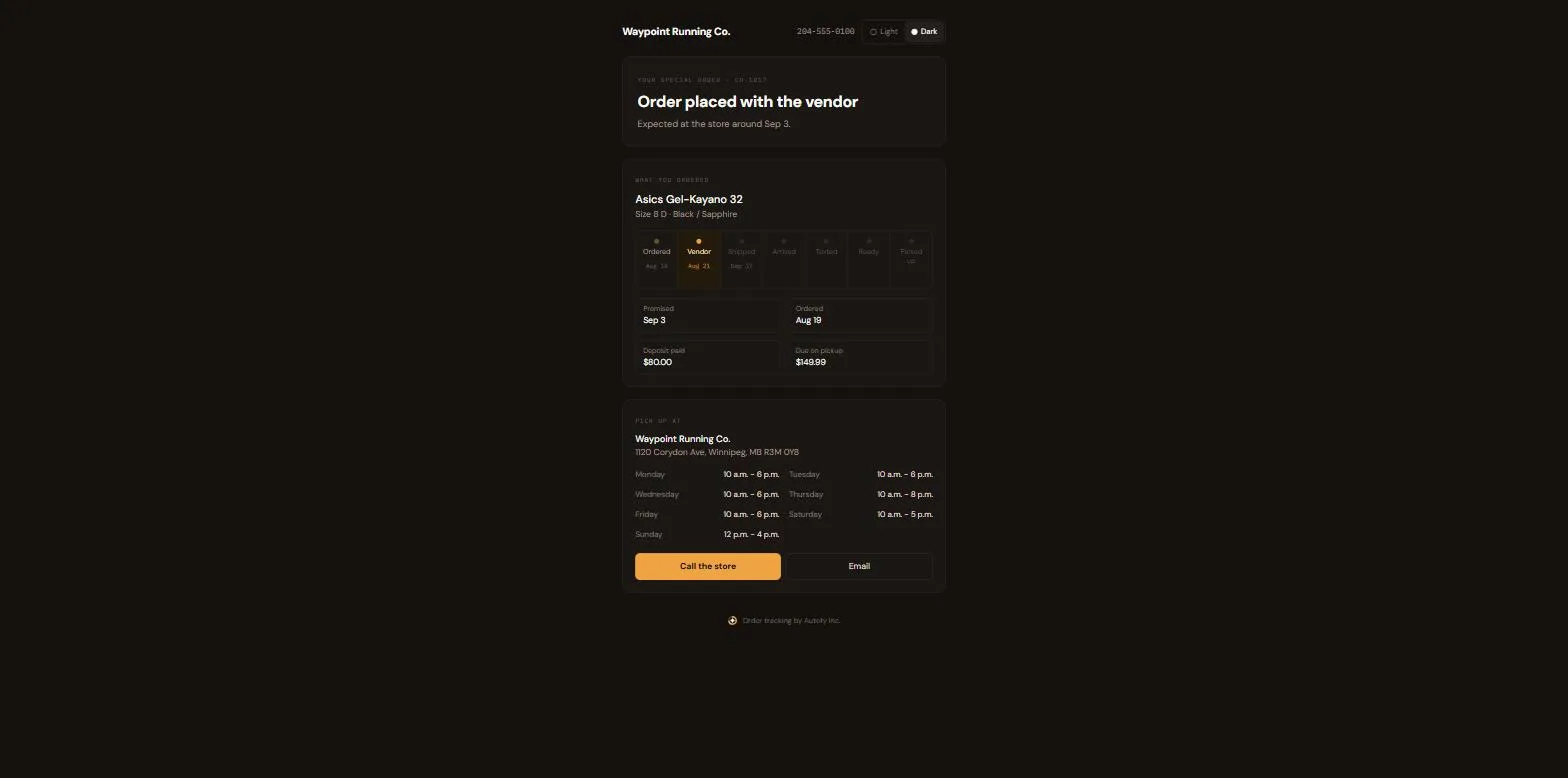
The tracking page below shows one example: an $80 deposit against a $149.99 balance on a pair of Asics Gel-Kayano 32s, a little over half the total. That split isn't a rule, it's what one shop landed on for one order. The number that's right for a butcher's Friday order for a wedding is not the number that's right for a bike shop's frame order, and neither owes the other an explanation.
Write the policy down before you need it
The failure isn't picking the wrong percentage. It's picking a different one depending on who's at the counter and what kind of week it's been. A customer who hears "we usually ask for half" from one staff member and "that's up to you" from another has learned that the policy is a suggestion, and will act accordingly next time.
A written policy needs to answer three things, in a place any staff member can actually find it:
- Which orders need a deposit, using the same test above: stuck with it if they don't come back.
- How much, even if that's a range rather than one fixed figure ("half for custom orders, none for anything we can restock").
- What happens to it, covered next.
None of this requires software. A card taped by the register with three lines on it beats a rule that only lives in the manager's head, which is the same failure this whole six-stage framework is built to catch: the process works fine until the one person who knows it isn't the one standing at the counter.
What happens to the deposit when things go wrong
A deposit is a hold on the customer's commitment. It isn't payment for something they haven't received yet, and how you treat it should follow from that.
- The order runs late and the customer wants out. Refund it in full, without an argument. You're the one who didn't deliver on the timeline; asking them to eat the cost of your delay just to keep the sale is the fastest way to lose the relationship along with it. What to actually say when you make that call matters as much as what happens to the money.
- You can't get the item at all. Full refund, same day if you can manage it. This one is entirely on the shop.
- The customer simply changes their mind, and you delivered on time. This is where your written policy earns its keep. Whatever you decided, apply it the way it's written, and make sure the customer heard it when they paid, not when they're asking for the money back.
Why doesn't the till just hold this for you?
Because in most cases, it wasn't built to. A deposit against a special order is a half-finished sale sitting open for days or weeks, and that's an awkward shape for software built around a transaction that starts and ends at the register.
Lightspeed X-Series is the strongest of the major systems at handling a special order end to end, ahead of both Shopify and WooCommerce, each of which stops even earlier. But its own documentation states that an unfulfilled sale must be paid in full before it can be marked packed (Lightspeed Retail X-Series, "Managing special orders", read 17 September 2026). That's awkward for exactly the shops this post is for: the ones taking half at the counter the way they always have.
Shopify POS Pro runs into a version of the same wall earlier. Its pickup flow requires the whole order in stock at the pickup location before it treats the sale as ready at all (Shopify Help Center, "Setting up pickup in store for online orders", read 17 September 2026), so a deposit against stock that hasn't arrived yet has nowhere in that flow to sit either.
None of that makes deposits a bad idea. It means the deposit and the balance owing are two numbers somebody, or something, has to keep straight from the day the customer pays until the day they collect.
Frequently asked questions
Do I need to give the customer a receipt for the deposit?
Yes, always, whether it's a printed slip or a line on their order confirmation. A deposit with no record is a promise on both sides with nothing to point to if either side remembers it differently.
Should a deposit ever be 100% of the price?
For an order you genuinely cannot recover from, a permanently altered custom piece, a perishable order sized for one event, full payment upfront is defensible and common. Say so plainly when the order is placed rather than let the customer assume it's negotiable.
What if the customer paid the deposit on a card that later gets declined for the balance?
That's a conversation to have before you release the item, not after. Treat it the same as any other unpaid balance: the order isn't handed over until it's settled, deposit or no deposit.
Can I raise my deposit policy for one customer and not others?
You can, but write down why, and be ready to explain it if asked. A policy applied selectively without a stated reason reads as favoritism even when it's genuinely about risk.
Where Autofy comes into it
Autofy tracks the deposit and the balance owing from the moment an order is promised, so the number on the tracking page above stays visible to the shop and the customer without anyone keeping a separate note. Tell us how deposits work in your shop today if you want to see it against your own numbers.
The policy itself, though, has nothing to do with software. It's a decision about risk that a shop makes once, writes down, and then applies the same way on a slow Tuesday as on a busy Saturday. That's true whichever system, or notebook, ends up holding the number.