Blog · · 6 min read
What happens to a special order when the vendor ships it short
You ordered nine and six arrived. Three customers are waiting on nothing. Here is who decides, why no POS helps you decide it, and what to say to the two people who lose.
- Special orders
- Retail operations
- Point of sale
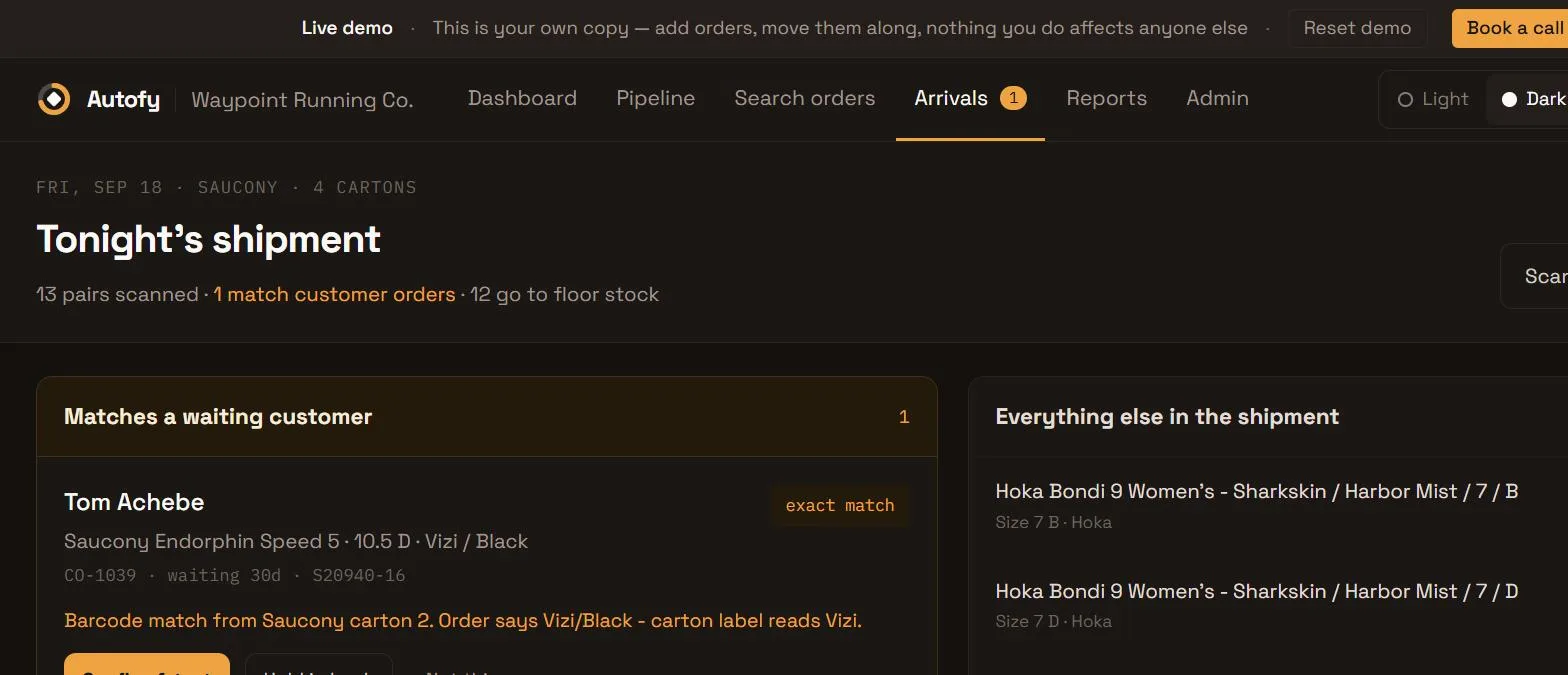
A short shipment turns receiving into a rationing decision, and no point-of-sale system will make that decision for you. You ordered nine, six arrived, and three people who are expecting a phone call are now waiting on nothing.
Key Takeaways
- A short shipment is a stage 04 failure with a twist: the carton arrived, but there is not enough of it to satisfy everyone who was promised something.
- No POS allocates a short delivery to named customers. Shopify, Lightspeed and WooCommerce all track stock levels; none of them tracks claims on that stock.
- The decision is a policy — order date, deposit taken, promised date, or who will be hurt most — and it should be written down before it is needed.
- The expensive part is not the shortage. It is the two customers who find out by waiting.
What counts as a short shipment?
A short shipment is any delivery where what arrived is less than what the purchase order said, discovered at the loading dock rather than announced by the vendor. It comes in three shapes, and they are not equally bad.
- Short count. You ordered nine, six came. The commonest, and the one this post is mostly about.
- Substituted. The right number arrived, but two are a different colourway or width from what the customer chose. This looks fine on a receiving screen and wrong at the counter.
- Split delivery. The rest is coming, maybe Thursday, maybe not. A short count you do not yet know is temporary.
All three produce the same problem at the same moment: more claims than goods.
Why doesn't the POS just tell you who gets them?
Because a POS tracks how many you have, not who they belong to. Receiving a carton increments a stock level. Nothing in that number remembers that three of those units were promised to named people on three different days.
That is the same gap that makes stage 04 — catching the arrival — the expensive stage in the six stages a special order travels: the goods are in the building and nothing looks wrong. A short shipment just makes it sharper, because now the system's silence has to be resolved by someone choosing between customers.
Read from each vendor's published documentation as of 17 September 2026:
- Shopify POS Pro keeps purchase orders in a separate app from the order the customer placed, and nothing links receiving back to a waiting order. Its pickup flow needs the entire order in stock at the pickup location to begin with (Shopify Help Center, "Setting up pickup in store for online orders"), so a partly-arrived special order has nowhere to sit.
- Lightspeed X-Series is the closest of the three: its special orders page nets demand against inbound vendor orders, and it prompts while receiving. But the prompt fires once, to whoever happens to be receiving that carton, and its documentation still asks staff to contact the customer themselves (Lightspeed Retail X-Series, "Managing special orders"). A prompt seen by one person at the back door is not an allocation record.
- WooCommerce has no restock or arrival event in core at all. Its backorder notice fires at purchase time, not on arrival (WooCommerce, "Product Editor settings"), so a short delivery is invisible to it.
Features a vendor marks beta may differ by account and plan. The quoted wording and caveats are on the full POS comparison.
Who should get the units that did arrive?
Pick a rule now, while nobody is waiting, and write it where staff can find it. Any of these is defensible. Having none is not.
- First promised, first served. Order date decides. Easiest to explain to the person who loses, because it is not a judgement about them.
- Deposit first. Anyone who put money down gets priority. Reasonable, and it quietly tells you deposits are doing more work than you thought.
- Promised date first. Whoever was given the earliest pickup date wins, regardless of when they ordered. Best when you have promised specific days.
- Need first. The race is Saturday; the wedding is Friday. Honest, and the hardest to apply consistently, because it invites argument.
| Rule | Decided by | Easiest to explain when | Watch out for |
|---|---|---|---|
| First promised, first served | Order date | The wait has been long and uneven | Ignores who needs it soonest |
| Deposit first | Money down | You already take deposits | Tells customers deposits buy priority |
| Promised date first | The date you gave | You quote specific pickup days | Punishes the customer you were cautious with |
| Need first | Staff judgement | The occasion is genuinely fixed | Hardest to apply the same way twice |
The rule matters less than the fact that it exists and is the same on a Tuesday as on a Saturday. The failure mode here is not choosing badly. It is choosing differently each time, so that staff cannot explain the decision and customers compare notes.
What do you say to the customers who did not get one?
Say it on the day the carton lands, not on the day they ask.
That is the whole difference. A customer told on Tuesday that their item slipped to next week is a customer with information. The same customer, told nothing, finds out by ringing on Friday — and by then the problem is not the shortage, it is that you knew and they did not.
Three things worth putting in that message:
- What actually happened, plainly. The vendor sent six of nine.
- What you have done about it, not what you intend to feel about it. The balance is reordered, and here is the date the vendor gave.
- What they can decide. Wait, take a substitute, or have the deposit back. Giving the choice back is what stops the message being an apology with no content.
None of that needs software. It needs someone to know, on the day, that the message is owed.
How do you tell if short shipments are costing you?
Take your last ten short deliveries and ask:
- Who decided who got the stock, and could they tell you why?
- How long after the carton landed did the customers who lost out find out?
- Did the balance get reordered, or did it become a new conversation weeks later?
If the answer to the second is "when they called," the gap is not your vendor. It is that nothing in your shop turned the shortage into a task with a name attached.
Frequently asked questions
Should I take deposits so short shipments are easier to allocate?
It helps, but that is not the main reason to take one. A deposit gives you a defensible priority rule and it tells you who is serious. Note that it also constrains your system choice: Lightspeed cannot mark an order packed until it is paid in full, which is awkward if you take half at the counter the way most shops do.
Is a short shipment the vendor's problem to communicate?
Practically, no. The vendor told you by sending six. Whether the customer hears about it is your side of the line, and they will judge the shop rather than the supplier.
What if the rest is arriving in a few days anyway?
Then it is a split delivery, and the honest message is different: nothing has gone wrong, the balance is dated. The mistake is staying quiet because it feels like a non-event. It is only a non-event to the person who already knows.
Where Autofy comes into it
Autofy attaches every waiting customer to the vendor order, so a carton that arrives short shows you which claims it satisfies and which it does not, on the day it lands. If you want to see it against your own orders, tell us how they move through your shop today.
But the rule for who gets the units is yours either way, and writing it down costs nothing. Most of what goes wrong with a short shipment happens in the days between the carton landing and the customer finding out — and that gap closes with a decision, not a purchase.