Blog · · 6 min read
The phone call you make when a special order is late
What to say when a special order runs late: name what happened, what you've done about it, and the choice the customer gets to make.
- Special orders
- Retail operations
Make the call before the promised date passes, the moment you can see it's going to slip, not after the customer rings to ask where their order is. The message itself has three parts: what actually happened, what you've already done about it, and what the customer gets to decide next. Leave any one of those out and the call reads as an apology with nothing behind it.
Key Takeaways
- Call when the order is going to miss its promised date, not when the customer's patience runs out. You usually see it first.
- Say three things: what happened, what you've done about it, and what the customer can now decide (wait, take a substitute, or get the deposit back).
- Vague reassurance like "we'll call you when it comes in" promises nothing back. Avoid making it the whole message.
- No new date yet? Say that plainly and give a date you'll follow up by instead of guessing a number to sound certain.
- Never make the same missed promise to the same customer twice without a real explanation. The second broken date costs more than the first.
When to make the call
The trigger for this call isn't the customer's patience running out. It's the order crossing its promised date, or you seeing that it's about to, which is usually visible to you first. A vendor's ship date slips, a carton doesn't show up on the truck it was supposed to be on, a backorder gets pushed another two weeks. You know that before the customer does, which means you have a choice: tell them now, or let them find out by asking.
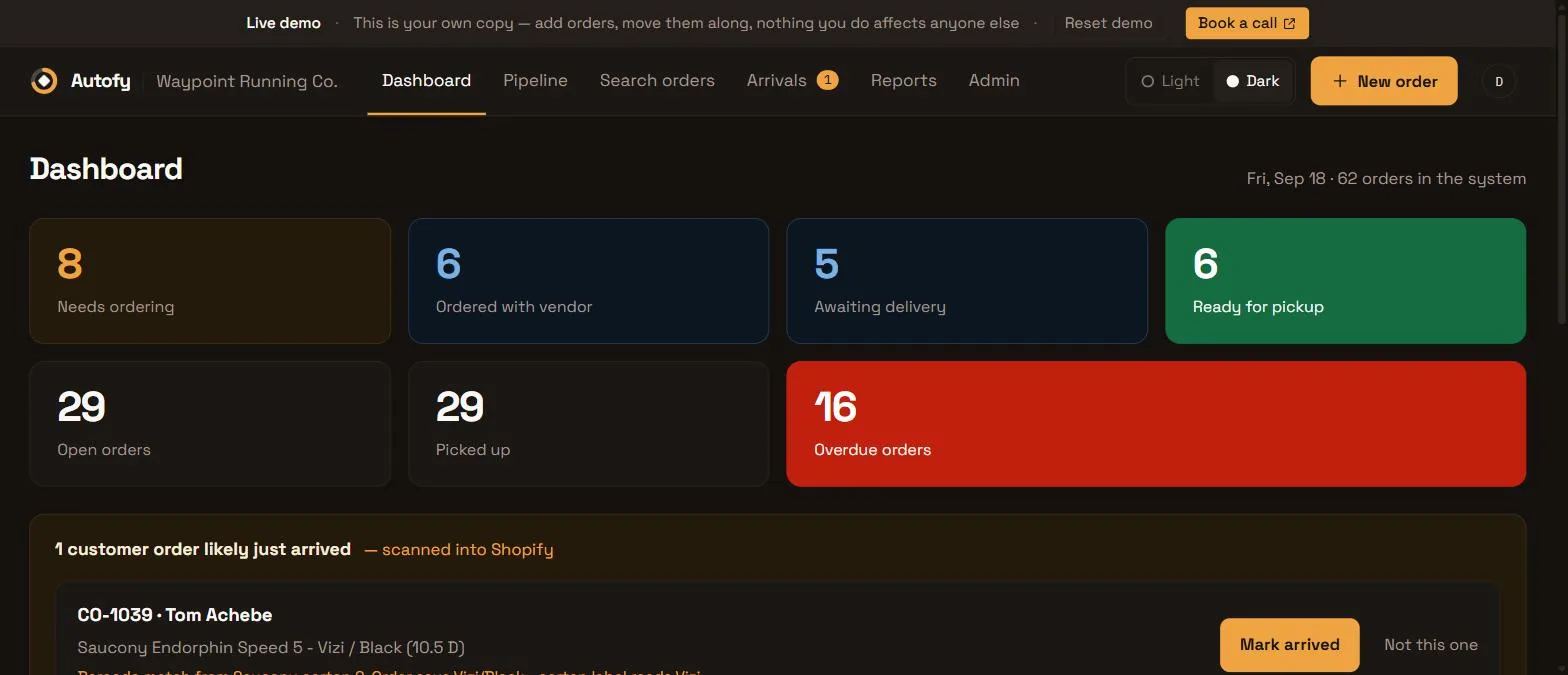
That gap is the whole problem. A board with dozens of special orders in flight can't rely on someone remembering which ones are aging, so the useful version of this trigger is a flag, not a memory. The image below shows what that looks like on a shop's own board: sixteen orders marked overdue against twenty-nine open, sitting apart from everything still on schedule. Nothing about that tile tells staff to call. It just tells them who needs one.
Calling early costs you an uncomfortable minute. Calling late costs you the same minute plus a customer who now believes you were hoping they'd forget.
What to actually say
Three things belong in this message. Leave one out and it stops doing its job.
- What actually happened, plainly. The vendor pushed the ship date. The size ran out and a reorder is in. Say the real reason in one sentence, not a vague "there's a delay."
- What you've already done about it. Reordered, escalated, called the vendor yourself, whatever is true. This is the part that shows the customer they aren't the one who has to chase it.
- What they can decide. Keep waiting, take a substitute if one genuinely fits, or get the deposit back. Handing the decision back is what turns the call from an apology into something useful.
That third point does the most work. A customer who hears "it's late, sorry" has learned something but can't act on it. A customer who hears "it's late, here's why, and here's what you can do" has an actual choice in front of them, which is usually what settles the conversation. It's the same three-part shape that works when a vendor ships an order short: the trigger changes, but what the customer needs to hear doesn't.
What breaks the call
A few habits turn an honest late-order call into a worse one.
Vague reassurance is the biggest offender. "We'll call you when it comes in" sounds like an update but promises nothing: no reason, no date, no commitment to reach out again if it slips further. It buys a moment of quiet at the counter and costs trust later.
Promising a second date you can't back is close behind. If the vendor hasn't confirmed anything, don't invent a week to sound certain. A customer who hears a specific date treats it as a real promise, and a second broken promise reads very differently from the first one.
Repeating that pattern with the same customer is the one to avoid at all costs. One missed date is a supply chain problem. A second missed date, delivered the same vague way, reads as a shop that either doesn't know or doesn't care. Neither is true most of the time, but the customer has no way to tell the difference.
If you genuinely don't have a new date yet
Say that plainly. "I don't have a firm date from the vendor yet" is a complete, honest sentence, and customers generally accept it better than a guess dressed up as certainty.
What you owe them instead is a date you will follow up by, even if that date is nothing more than "I'll check in by Friday either way." That's a promise about the update, not about the order, and it's one you can actually keep. Following through on it, even to say "still no date, checking again Monday," does more for trust than a confident-sounding delivery estimate that turns out wrong.
Why isn't this call already built into your system?
Because in most cases, no system does it for you. Lightspeed X-Series is the strongest of the major point-of-sale platforms at tracking a special order right up to this point, ahead of Shopify and WooCommerce, each of which stops earlier. But its own documentation for this exact stage instructs the shop to contact the customer and let them know the order is ready for collection (Lightspeed Retail X-Series, "Managing special orders", read 17 September 2026). Nothing in the system records whether that call actually happened. That isn't a knock on the staff making the call. It's a gap in the tool. The system gets the order to the counter and then steps back, the same way it does at several other points in a special order's life.
That means the call itself is always going to be a person's job. What can change is whether anyone notices, on the right day, that it's owed.
Frequently asked questions
Should I offer a discount when an order runs late?
Not automatically. Lead with the three-part message and the real choice first, and let a discount stay something you offer only if you'd genuinely regret losing that customer over the delay. Offered reflexively, it starts to read as compensation for a problem you expect to keep having.
Should I call, or is a text enough?
Call for the first conversation about a late order. It needs a real answer back, wait, substitute, or refund, and a text makes that harder to have. Once the customer has decided, a text or a quick written update is fine for the routine follow-ups after that.
What if the customer wants their deposit back?
Give it back without an argument. A deposit is a hold on their commitment, not payment for something they haven't received. Refusing to return it over a delay you caused will cost you the relationship, for money you were never fully owed anyway.
What if I already gave them a new date and it's slipping again?
Don't invent a third one to sound confident. Say plainly that the new date isn't going to hold either, and this time let the customer choose whether they want to keep waiting at all. A second broken promise is the moment most customers decide to cancel, and pretending otherwise usually makes it worse.
Where Autofy comes into it
Autofy's board is what flagged the sixteen overdue orders in the image above, so staff know which customers are waiting on a call before the customer has to ask. What to actually say on that call is still up to the person making it. Tell us how special orders move through your shop today if you want to see how the board surfaces that list.
But most of what makes this call work has nothing to do with software. It's a habit: call before the promise breaks, say what happened, and give the customer something real to decide. That's true whether the flag comes from a board or from someone checking a spreadsheet on a Friday afternoon.