Blog · · 10 min read
The 7 best special order software tools for retailers (2026)
Seven special order tools compared from their own documentation: what each tracks, whether it tells the customer, and what it costs. Read September 2026.
- Special orders
- Software
- Point of sale
Special order software keeps track of an item a customer asked for that isn't on your shelf, from the moment they ask to the moment they pick it up. Most tools sold under that name are full point-of-sale systems with a special order screen inside. One is built for nothing else.
This list compares seven of them, read from each vendor's own documentation and pricing pages in September 2026. We make one of the seven, Autofy, and we ranked it first. Weigh that accordingly: the criteria are below, and every claim about another vendor links to that vendor's own page so you can check it.
Key Takeaways
- Best overall for independent retailers: the Autofy Special Order Tracker. It's the only tool here built only for special orders, it works alongside the POS you already run, and it emails the customer automatically when their item arrives.
- Best if you're replacing your POS anyway: Lightspeed Retail. Its own special orders feature is the strongest of the mainstream systems, though its documentation leaves telling the customer to staff.
- Best for furniture and big-ticket stores: STORIS. Special order sales generate their own purchase orders, with templates for fabrics and finishes.
- Six of the seven are full POS or business systems. Getting their special order features means moving your whole store onto them.
- Five of the seven publish a price. STORIS and Windward quote on request.
How do these seven compare at a glance?
Listed in ranked order. The columns follow the order most shops decide in: whether it works with the till you already have, whether it tells the customer, and what it costs.
| Tool | Best for | Works with your current POS | Tells the customer when it arrives | Published price |
|---|---|---|---|---|
| Autofy Special Order Tracker | Independent retailers of any kind | Yes: Shopify, Lightspeed, WooCommerce, or none | Yes, automatic email | $149 or $199 CAD a month, plus setup |
| Lightspeed Retail | Shops replacing their POS | No, it is the POS | No, staff contact the customer | $89 to $289 USD a month |
| STORIS | Furniture and home furnishings | No | Not stated in the pages we read | Quote on request |
| Windward System Five | Hardware, building materials, home goods | No | Not stated in the pages we read | Custom quote |
| MicroBiz | Budget POS for specialty stores | No | No, staff are alerted to contact them | $65 or $95 USD a month |
| Celerant | Multi-store chains that also sell online | No | Not stated for special orders | From $125 a month |
| Shopify POS | Shops already selling on Shopify | No, it is the POS | Yes | CA$119 per location a month, plus a Shopify plan |
Prices are as listed on each vendor's site on 24 September 2026, in the currency each one shows. Vendors change prices and features, so check the linked page before you buy.
1. Autofy Special Order Tracker: best overall for independent retailers
Autofy is the only tool on this list that does nothing but special orders, and it does all of them without asking you to change your POS. Every other entry is a system you'd move your whole store onto.
A special order passes through six stages: take it at the counter, hold it with no stock, link the vendor order, catch the arrival, tell the customer, and chase it to pickup. The first three are paperwork. The last three are memory, and that's where most systems hand the job back to a person. Autofy carries all six, and our stage-by-stage POS comparison shows where Shopify, Lightspeed and WooCommerce each stop.
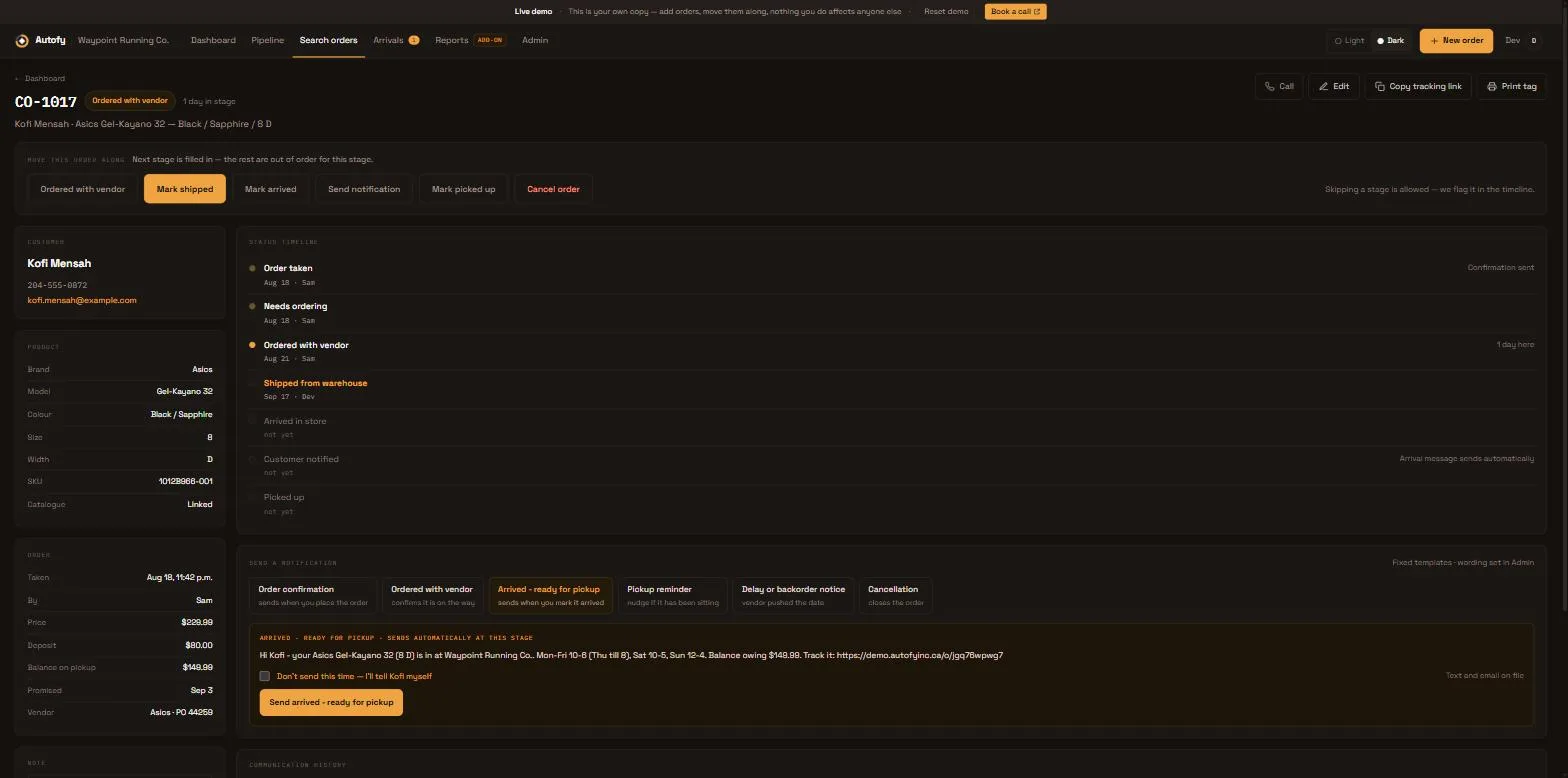
What it does:
- Takes the order in about twenty seconds. Customer, item and the details that matter, in your own fields: size and width, weight, ring size, frame size.
- Catches the arrival for you. Connected to Shopify, Lightspeed or WooCommerce, Autofy watches your inventory with read-only access. The moment an ordered item lands, the order moves to Arrived. On any other system, staff mark it arrived with one tap.
- Tells the customer automatically, by email, in your store's name. Nobody has to remember to call.
- Gives the customer their own status page, a link they check instead of phoning you.
- Surfaces stale orders. The board is colour-coded by age, and aging alerts raise an order before the customer has to chase it.
- Keeps the history. Notes and full history on every order, findable in seconds.
Proof: City Park Runners, an independent running store in Winnipeg, tracked 127 special orders in its first six weeks on the tracker. It collected 84% of resolved orders, with 12 staff using it day to day. About $23,000 of special-order revenue went through the system. That's revenue tracked, not revenue saved.
Pricing: Core is $149 a month and Growth is $199 a month, which adds a reporting dashboard and automatic review requests. Setup is a one-time $750, or $1,500 with your branding and your open orders migrated in. Each extra location is $99 a month. All prices are in CAD, with unlimited orders and staff, no per-order fees and no contract. Full details are on the pricing page.
Coming soon: a stock-out and inventory-level add-on. It's built to show inventory levels and flag stock-outs alongside your special orders. It isn't available yet and has no announced price or date. We'll update this post when it ships.
The guarantee: "You will stop losing special orders." The full terms spell out what happens if the system ever misses one.
Best for: any independent retailer that orders things in for customers and doesn't want to replace its till to track them. You can try it in the live demo, with no signup and no login.
2. Lightspeed Retail: best if you're replacing your POS anyway
Lightspeed has the strongest built-in special orders of the mainstream POS systems. In our breakdown of where each POS stops, it carries an order through the first three stages on its own: taking it, holding it with no stock, and linking the vendor order (a feature Lightspeed marks as beta).
Where it stops is telling the customer. Lightspeed's special orders documentation instructs staff to contact the customer to let them know the order is ready for collection (Lightspeed Retail X-Series, "Managing special orders", read 17 September 2026). That step is a person's job, not the system's.
Pricing: $89, $149 or $289 USD a month for the Basic, Core and Plus plans, billed monthly, with savings for annual billing (Lightspeed Retail pricing). Lightspeed notes that prices and fees can vary by business type.
Best for: a shop choosing a new POS for everything, where special orders are one need among many.
3. STORIS: best for furniture and big-ticket home stores

STORIS is built for home furnishings, and its special orders reflect it. Staff sell custom products from templates, with dropdowns for attributes like fabric and finish. STORIS states that "Special Order sales automatically generate related purchase orders" (STORIS, Point of Sale Software).
The same page lists bedding, appliances, casual furniture and spas among the industries it serves. It's a full retail system, so taking it on means running the store on STORIS.
Pricing: not published. STORIS asks you to request a demo.
Best for: furniture, mattress and appliance retailers selling custom, made-to-order goods at high ticket prices.
4. Windward System Five: best for hardware and home goods
Windward ties each special order to the purchase order that fills it. In its own words, "When a special order is created, the parts on the purchase order are assigned to that customer's specific work order line item." Then, "Once the purchase order is received, the special order is automatically filled" (Windward, "Mastering Special Orders", 5 September 2024).
System Five is a complete business system covering point of sale, inventory, purchasing and accounting, aimed at home goods, building materials, rental and similar businesses.
Pricing: custom quote. Windward says no two systems are priced the same (Windward pricing).
Best for: hardware, building supply and home goods stores that want special orders inside one system that also runs their accounting.
5. MicroBiz: best budget POS for specialty stores
MicroBiz flags a special order the moment its stock arrives, then hands the call to staff. Items are marked as special orders when sold, which puts them on a list in purchasing. On receiving, MicroBiz "alerts the user that the item is attached to a customer order, so that the customer can be contacted" (MicroBiz, furniture and home decor POS). It also takes deposits.
Its list of stores served is unusually wide: appliance stores, firearms and ammunition, swimming pool and spa, furniture, and feed and farm supply among them.
Pricing: $65 USD a month for Standard or $95 for Enterprise, each with one store and register, plus $32.50 a month per extra register (MicroBiz pricing).
Best for: small specialty stores that need a whole POS at a low monthly price and are happy to make the arrival call themselves.
6. Celerant: best for multi-store chains that also sell online

Celerant is a full retail system with special orders inside it. Its furniture page says stores can "create and process special orders for custom items" within the POS (Celerant, Home Goods and Furniture). The same page lists verticals from bicycle and footwear to pet supply and sporting goods.
The page didn't describe customer notifications for special orders specifically, so we haven't claimed any.
Pricing: Cumulus Retail starts at $125 a month, with e-commerce from $250 and the furniture all-in-one from $350, as listed on the same page.
Best for: growing multi-store retailers that want POS and e-commerce from one vendor.
7. Shopify POS: best if you already sell online on Shopify
Shopify POS is the natural choice if your online store already runs on Shopify, but it can't hold a special order it has no stock for. Shopify's documentation states that by default, pickup in store is available only when the entire order is in stock at the pickup location (Shopify Help Center, "Setting up pickup in store", read 17 September 2026). A vendor isn't one of your locations.
Once an item is in stock, Shopify handles telling the customer and chasing the pickup well. It's the middle of the special order, before the stock exists, that falls back on staff.
Pricing: POS Pro is CA$119 a month per location, on top of a Shopify plan (Shopify POS pricing).
Best for: shops that sell mainly online through Shopify and take special orders rarely.
How we selected and ranked these
We looked for tools that describe a special order workflow in their own documentation, not just "order tracking", which in most roundups means tracking parcels shipped from an online store. That ruled out shipping trackers and order management systems built for warehouses.
Each tool was ranked on five things, weighted toward an independent shop rather than a chain:
- Covers the whole order, from the counter to pickup, not just the first stages.
- Tells the customer without a person remembering to.
- Works with the POS the shop already has, or requires replacing it.
- Publishes its price.
- Fits an independent retailer's size and budget.
This is a research review, not a hands-on test. We read each vendor's own pages on 24 September 2026, and the Shopify and Lightspeed special order documentation on 17 September 2026. No vendor paid for placement. We make Autofy, which is ranked first.
Product names and logos are trademarks of their respective owners. Autofy is not affiliated with, endorsed by, or sponsored by any other company on this list.
Frequently asked questions
What is special order software?
Special order software tracks items a customer has asked you to get in, from the request to the pickup. It records who wants what, links it to the order you place with the vendor, notices when it arrives, and makes sure the customer hears about it.
Do I need to replace my POS to track special orders?
No. Six of the seven tools here are full POS or business systems, so using their special orders means switching your store over. Autofy runs alongside Shopify, Lightspeed or WooCommerce, or with no POS at all, where staff mark arrivals with one tap.
Can't I just use a spreadsheet?
For a handful of orders a month, often yes. The trouble starts at arrival. A spreadsheet doesn't notice when the carton lands, and it doesn't tell the customer. That's the gap described in the phone call you make when a special order is late.
How much does special order software cost?
Five of the seven publish prices. MicroBiz starts at $65 USD a month, Lightspeed at $89 USD and Celerant at $125. Shopify POS Pro is CA$119 per location on top of a Shopify plan, and Autofy is $149 or $199 CAD a month plus a one-time setup. STORIS and Windward quote on request.
Should I take a deposit on a special order?
Usually, yes, and most of these tools can record one. How much depends on how returnable the item is. We cover that in when to take a deposit on a special order.
Which one should you choose?
If you want special orders handled without changing the till you already trust, the Autofy Special Order Tracker is the best fit, and it's the one we built for exactly that. If you're replacing your POS anyway, Lightspeed Retail has the strongest special orders of the mainstream systems. Furniture and big-ticket stores should look hard at STORIS.
Whichever you pick, check it against the six stages rather than the phrase "special orders" on a feature list. The stages where a person has to remember are the ones that cost you customers. If you'd like to see how Autofy would carry yours, tell us how special orders move through your shop today.